
Britain's relationship with hair styling is complicated. According to industry data, UK women are among the highest consumers of hair colour in Europe, and heat styling tools - straighteners, curling wands, blow-dryers - are used daily by a significant proportion of the population. Add in chemical treatments like perms, relaxers and keratin treatments, and the cumulative damage inflicted on the average British person's hair becomes considerable.
The result is a widespread problem: brittle, over-processed hair that snaps at the slightest tension, loses moisture almost as fast as it gains it and lacks the elasticity and shine of healthy strands. If this sounds familiar, you are far from alone - and the solution may be simpler, and more sustainable, than you expect.
Hair conditioner bars are earning well-deserved attention as a genuinely effective tool for repairing damaged hair. But not all conditioner bars are equal. The difference between a product that restores hair and one that merely coats it lies in its ingredients and formulation. This guide explains how hair conditioner bars work, what to look for in the ingredients, how to use them correctly and why Karmic Skin's approach to hair repair makes it stand out.
Understanding Hair Damage: What Over-Processing Actually Does
To repair damaged hair, you first need to understand what damage looks like at a structural level.
Healthy hair is composed of three layers. The innermost layer - the medulla - provides structure. The cortex, which makes up the bulk of the hair shaft, contains the proteins (primarily keratin) that give hair its strength and elasticity. The outermost layer - the cuticle - is a protective sheath of overlapping scales that, when closed and flat, protect the cortex and give hair its smooth, shiny appearance.
Over-processing disrupts all three layers:
Heat damage: Temperatures above approximately 150°C begin to alter the structure of keratin proteins in the cortex. At higher temperatures - common with many straighteners and curling wands - the protein bonds that give hair its tensile strength are permanently disrupted. The cuticle is also physically scorched and may be stripped away entirely in the most severely damaged sections.
Chemical damage from bleaching: Bleach uses hydrogen peroxide and persulphate salts to both lift natural pigment and open the cuticle. At high concentrations or with frequent use, bleach degrades the disulphide bonds within the cortex - the same bonds that give hair its strength and curl pattern. Severely bleached hair has significantly lower tensile strength than virgin hair and is far more prone to breakage.
Chemical damage from colouring: Permanent colour uses a similar mechanism to bleaching, though typically at lower concentrations. Repeated colouring cycles compound the damage, gradually depleting the hair's protein reserves and increasing porosity.
Mechanical damage: Tight hair elastics, rough towel-drying, aggressive brushing and heat styling without protection all cause physical damage to the cuticle over time, increasing porosity and vulnerability.
Brittle hair - hair that snaps rather than stretches when pulled - is typically suffering from both protein depletion (loss of structural keratin) and moisture deficiency (low water content within the hair shaft). Effective repair must address both.
How Hair Conditioner Bars Work
A hair conditioner bar is a solid, concentrated conditioning product that, when activated with water, delivers conditioning actives to the hair shaft. Unlike a rinse-out liquid conditioner - which is typically 70-80% water with a relatively small concentration of active ingredients - a conditioner bar is almost entirely active content. There is no water to dilute the conditioning agents, which means more beneficial ingredients reach your hair per use.
The core function of a conditioner bar is to:
1. Deposit conditioning agents onto the hair shaft - primarily cationic (positively charged) conditioning molecules that are attracted to the negatively charged surface of damaged hair, where they adhere and provide smoothing, detangling and moisture-sealing benefits.
2. Deliver emollient oils and butters that penetrate or coat the hair shaft, restoring flexibility and reducing brittleness.
3. Seal the cuticle - particularly effective when rinsed with cool water, which contracts the cuticle around the conditioned shaft.
4. Reduce friction between strands, minimising the mechanical damage caused by detangling wet hair.
For damaged hair, the concentrated nature of a conditioner bar means that each wash delivers a meaningful dose of conditioning actives - not a diluted splash.
Key Ingredients for Damaged Hair Repair
Plant-Based Keratin Alternatives
Keratin protein treatments have become popular for their ability to temporarily strengthen damaged hair. However, conventional keratin treatments often use formaldehyde or formaldehyde-releasing preservatives - classified as carcinogens - and the protein used is typically sourced from animals.
Plant-based alternatives offer similar structural benefits without the ethical or health concerns. Hydrolysed wheat protein and hydrolysed soy protein are small enough to penetrate the hair cuticle and cortex, temporarily filling in protein gaps left by chemical damage. Hydrolysed quinoa protein is another vegan option with an amino acid profile that closely mimics that of human hair.
These plant proteins do not permanently repair the hair - no topical product can fully reverse chemical damage - but they significantly improve tensile strength, elasticity and the hair's ability to retain moisture during the period between applications.
Ayurvedic Herbs
Ayurvedic hair care has a multi-thousand-year history of addressing hair damage and hair loss through plant-based botanicals. Several key Ayurvedic ingredients are particularly relevant for damaged, brittle hair:
Amla (Indian Gooseberry): Extraordinarily rich in vitamin C and antioxidants, amla supports the scalp and strengthens hair at the root. It is also known to help prevent premature colour loss and to add natural shine to dull, damaged strands.
Brahmi: Traditionally used to strengthen hair and reduce breakage. Brahmi's alkaloids are believed to nourish the hair root and support the regeneration of healthy strands, making it particularly relevant for hair experiencing significant shedding alongside damage.
Bhringraj: Often called the "king of herbs" in Ayurvedic hair care, bhringraj is used to restore vitality to damaged and weakened hair. It has conditioning properties that improve hair texture and is associated with improved scalp circulation - supporting healthier new growth.
Hemp Seed Oil: Rich in essential fatty acids, it deeply nourishes hair, supports repair of damaged strands, improves moisture retention and enhances softness and shine.
Nourishing Plant Oils
Argan Oil: Rich in oleic and linoleic acids with high vitamin E content. Penetrates the hair shaft to restore flexibility and reduce the brittleness caused by protein loss. Also provides heat protection for future styling.
Marula Oil: Lightweight and fast-absorbing, marula oil is rich in oleic acid and antioxidants. It is particularly effective on porous, damaged hair because its small molecular structure allows it to penetrate readily, delivering conditioning without heaviness.
Avocado Oil: Rich in vitamins A, D and E, and with a high penetration capacity due to its relatively small molecular size compared with oils like coconut. Particularly good for deeply moisturising dry, brittle hair.
Sweet Almond Oil: High in vitamin E and mono-unsaturated fatty acids, sweet almond oil coats the hair shaft in a protective layer that reduces moisture loss and adds softness without greasiness.
Behentrimonium Methosulphate
Derived from rapeseed oil, this is the primary conditioning agent in most professional-grade solid conditioner bars. It is a gentle, biodegradable alternative to the quaternary ammonium compounds (quats) found in conventional conditioners, and it provides the characteristic slip and detangling effect that makes wet hair manageable - critically important for damaged hair, where wet combing is a high-risk activity for breakage.
How to Use a Hair Conditioner Bar Correctly
Correct application is essential for getting the maximum benefit from a conditioner bar - particularly for damaged hair.
Step 1: Cleanse first
Always use a conditioner bar after cleansing with a gentle, sulphate-free shampoo or shampoo bar. Attempting to condition over product build-up or excess oil prevents the conditioning actives from reaching the hair shaft.
Step 2: Warm the bar
Wet both the bar and your hair thoroughly. Hold the bar in your palms for a few seconds to soften it slightly.
Step 3: Apply to mid-lengths and ends
Swipe the bar directly along the hair from mid-length to ends, focusing on the areas of greatest damage - typically the ends and any sections that have been bleached or coloured most frequently. For very damaged hair, you can also work the bar between your palms to emulsify a small amount and then apply with your hands.
Step 4: Distribute and leave
Use a wide-tooth comb or your fingers to distribute the conditioner evenly through the hair. Leave for 2-5 minutes. For intensive repair, cover with a shower cap and leave for 10-15 minutes to allow the conditioning actives to penetrate.
Step 5: Rinse with cool water
A thorough, cool-water rinse removes excess conditioning agents (which, if left on, can cause build-up and limpness) while contracting the cuticle around the conditioned shaft - sealing in the moisture and conditioning benefits.
Why Karmic Skin's Hair Conditioner Bar Stands Apart
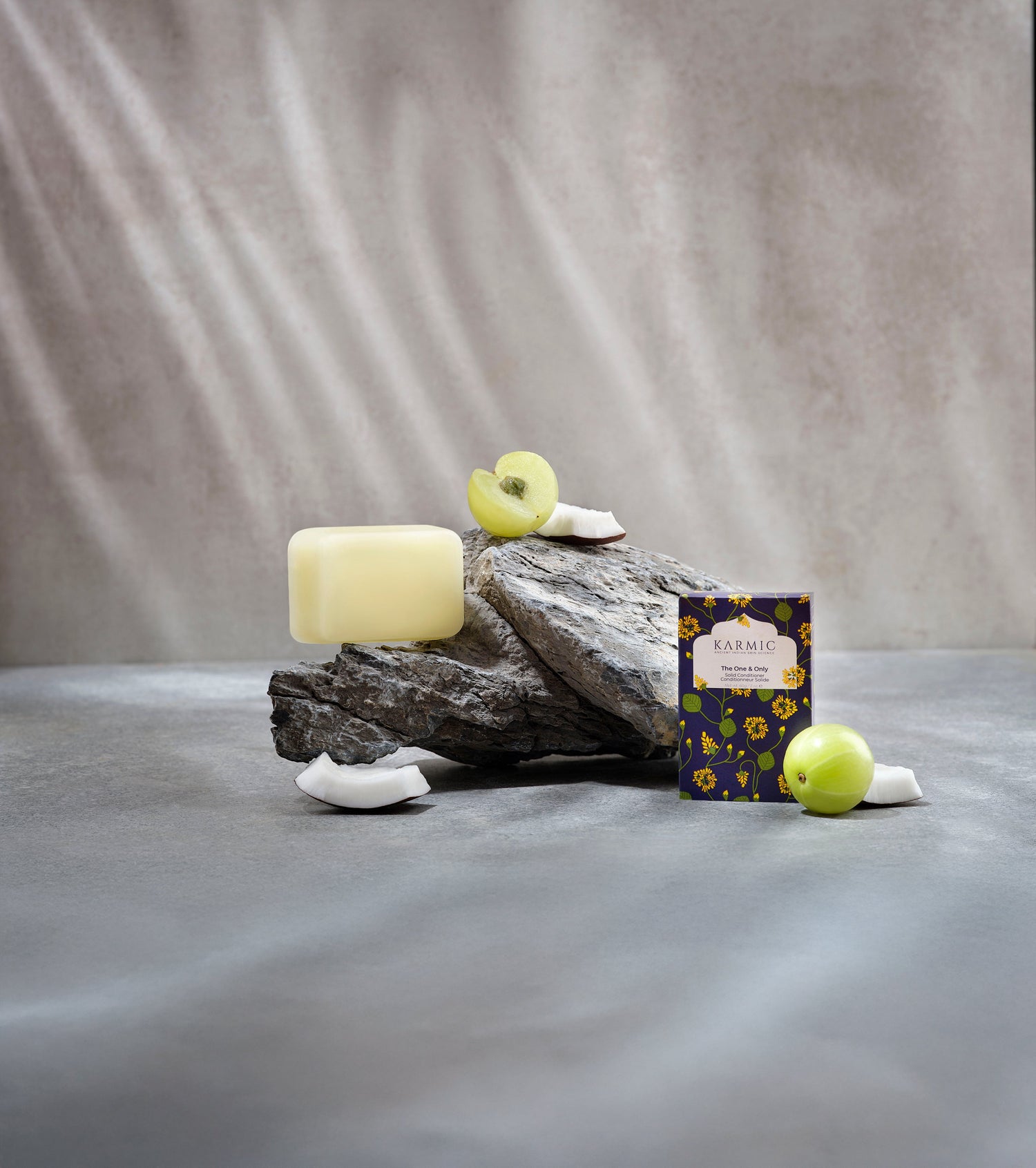
Our hair conditioner bar brings together Ayurvedic herbal tradition and contemporary plant chemistry in a formulation that is genuinely designed for damaged hair repair - not just surface smoothing.
The bar is fully vegan, free from silicones, parabens and synthetic fragrances, and is packaged in minimal, recyclable materials. It is cruelty-free and suitable for all hair types, though particularly well-suited to the dry, porous, brittle hair that results from over-processing.
By choosing a product that addresses the actual mechanisms of hair damage - protein depletion, moisture loss and cuticle disruption - rather than simply coating the hair with synthetic polymers, you are investing in long-term hair health rather than short-term appearances.
Over weeks of consistent use, well-formulated conditioner bars genuinely change the texture and resilience of damaged hair. Breakage decreases. Moisture retention improves. The hair becomes progressively less brittle and more elastic.
For hair that has been through the wringer - and, in the UK, that is a lot of hair - this kind of patient, ingredient-led approach is exactly what is needed.
Have a look at our hair conditioner bar and full repair range at karmicskin.com.


